Your Leading Xiamen Sino Star Machinery. Supplier


Xiamen Sino Star Machinery is a professional manufacturer of stone machines. We have been focus on stone machine industry for more than 15 years. Our product includes stone cutting machine, stone polishing machine, bridge saw machine, stone quarry machine, stone band saw cutting machine and many other stone machine.

 
Why Choose Us?
 
01/

High quality
We understand that stone processing demands robust and reliable machinery. Our equipment is engineered for longevity, ensuring that you get the most out of investment.

02/

Rich experience
We have been focus on stone machine industry for more than 15 years.

03/

Comprehensive range
We offer a comprehensive range of machines to suit every aspect of stone processing. Our extensive selection means you can find the perfect match for your specific needs.

04/

Professional team
We are not just selling machines, but on providing solutions. Our team of knowledgeable experts is always ready to assist with technical advice, and after-sales support.

First 12 Last
What is Band Saw Machine?


A bandsaw (also written band saw) is a power saw with a long, sharp blade consisting of a continuous band of toothed metal stretched between two or more wheels to cut material. They are used principally in woodworking, metalworking, and lumbering, but may cut a variety of materials. Advantages include uniform cutting action as a result of an evenly distributed tooth load, and the ability to cut irregular or curved shapes like a jigsaw.[1] The minimum radius of a curve is determined by the width of the band and its kerf. Most bandsaws have two wheels rotating in the same plane, one of which is powered, although some may have three or four to distribute the load. The blade itself can come in a variety of sizes and tooth pitches (teeth per inch, or TPI), which enables the machine to be highly versatile and able to cut a wide variety of materials including wood, metal and plastic.

Benefits of Band Saw Machine
 

Bandsaws can cut irregular shapes
Got a project that requires wood to be cut at acute angles? You won’t run into any issues with a bandsaw, that’s for certain. It’s easy to achieve completely smooth cuts regardless of the angles you’re cutting at.


You’re not restricted to a specific material
Most bandsaws can cut a variety of materials including timber, wood, metal and more. This means you won’t be confined to using particular wood types when creating new projects, which can open up new doors to creativity. Certain blade types are better suited to certain tasks, so ensure you’ve got the right blades for the job before cutting steel or hard woods.


Straight/cross-cuts are made easy
With other tools, making straight or cross cuts can take a lot of focus, care and attention. With a bandsaw, a mitre gauge will allow the user to make precision cuts without any wavering. Dual-bearing blade guide rollers and blade tracker adjustments also help keep things steady. This results in smooth, straightforward lines which will form the basis of any professional project.


Less wastage
One of the major advantages of using a bandsaw is that you will notice a huge reduction in wastage. This is because bandsaws have a smaller “kerf” than other cutting tools. Because band saws have narrow blades, you’ll even notice a reduction in the amount of sawdust produced.


Energy efficiency
Vertical bandsaws are ideal for domestic and small business applications. They use marginally less power in comparison to other wood/metal cutters and can therefore be considered energy-efficient. To keep production costs down, all good woodworkers should consider investing in bandsaws.

Types of Band Saw Machine
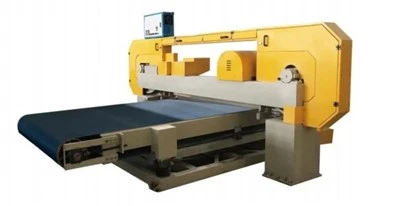
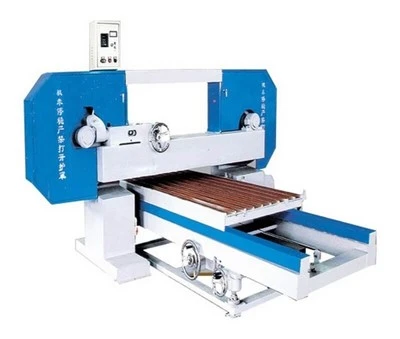
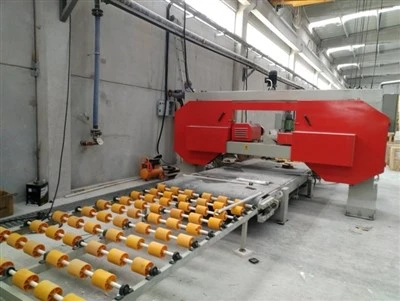
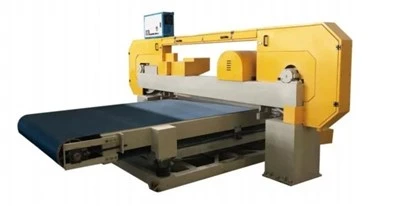
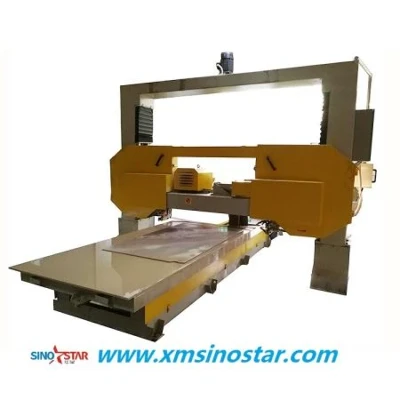
Marble Slab Horizontal Splitter
Stone Bush Hammering Machine
Stone Miter Saw
CNC Bridge Saw

Horizontal bandsaws
A horizontal bandsaw's long blade makes straight cuts through hard materials like metal, aluminum and steel. This type of bandsaw is used in commercial and industrial applications because of its large footprint.


Vertical bandsaws
Vertical bandsaws, also called vertical contouring saws, make more intricate and detailed cuts through softer materials like aluminum, non-ferrous metals and low-carbon steel.


Circular saws
Circular saws are ideal for manufacturing and industrial applications needing high performance and maximum safety. These motor-driven bandsaws are also called cold saws because they prevent the blade and metal from getting overheated, which can cause inefficient cutting.

Circular saws use a circular blade rather than a straight blade fitted between two wheels, which most other bandsaws use. Circular saws are usually free-standing. These bandsaws are ideal for cutting in small diameters and short lengths.


Fabrication mitering saws
In some fabrication projects, you might need to make angled miter or bevel cuts for correct assembly. A fabrication mitering saw can be handy in a workshop for these projects. Depending on how you place the material on the saw, the same fabrication mitering saw can create miter cuts and bevel cuts.


Two kinds of saw platforms for mitering saws are the swiveling-head saw and the swiveling-vise saw:


Swiveling-head mitering saw: The operator feeds the material into a swiveling-head mitering saw the same way as a saw without mitering capabilities. The head itself swivels to make the necessary cut. This machine requires a larger frame.
Swiveling-vise mitering saw: The vice grips the material at the required angle and swings the workpiece to the correct orientation. This machine requires additional clearance because of the movement of the workpiece.


Production saws
In a high-production environment, manufacturers need machines that deliver high accuracy on a high volume of workpieces. Production saws provide cutting-edge performance for various applications. These bandsaw types are highly efficient and work automatically to supply the accurate, high-volume cutting rates manufacturers need to stay on top of operations.

Production saws are horizontal and use a long blade to swing through workpieces fixed to a cutting plane. The dual-column design of a horizontal production saw keeps the blade stable as it moves through large workpieces. Production saw machines feature an enclosed "box" design which creates an enclosed operating environment and increases safety.


Specialty saws
Diamond saws:
Diamond saws use a diamond grit edge on their blade to achieve precision cuts on brittle materials. These saws are ideal for cutting through glass or quartz. Diamond saws come in various upright and horizontal positions to better accommodate different materials.
Vertical plate saws: When manufacturers need to cut through large blocks of materials that wouldn't fit on a typical saw, they turn to vertical plate saws. These saws have a large footprint to make room for solid plates and very heavy materials. Vertical plate saws use hydraulic lift tables to handle these large workpieces successfully.
Vertical contour bandsaw: High-velocity vertical contour bandsaws can cut up to 30 times faster than other conventional bandsaws. This capability makes them better suited for cutting through extremely tough materials.


Tube cutting saws
Many conventional saws can handle cutting through pipes and tubes, but if your application requires a high volume of tube cutting, adding a tube cutting saw to your workshop can boost productivity and accuracy. These saws are designed with blades to optimize tube cutting by cutting at special angles. You can make precise cuts on tubes and pipes of different diameters.


Application of Band Saw Machine


Woodworking: Bandsaws are often used in woodworking shops for cutting curves, irregular shapes, and intricate designs in wood. They are also used for resawing (cutting boards into thinner pieces) and ripping (cutting wood along the grain).


Metalworking: In metalworking, bandsaws are used to cut metal stock into various shapes and sizes. They are commonly used to cut metal pipes, bars, and sheets with precision.


Resawing: Bandsaws are ideal for resawing thick boards into thinner pieces. This is useful for creating bookmatched panels, veneers, or thinner stock for other woodworking projects.


Curved cuts: Bandsaws excel at making curved cuts in wood or metal. They can cut intricate shapes and designs with ease, making them a valuable tool for furniture makers, cabinetmakers, and artists.


Ripping: Bandsaws can be used for ripping lumber, which involves cutting wood along the grain to reduce its width. This is useful for creating narrow strips of wood for various projects.


Joinery: Bandsaws can be used for cutting joinery such as tenons, lap joints, and dovetails. They can make precise cuts that are essential for creating strong and well-fitted joints in woodworking.


Resculpting and shaping: Bandsaws are also used for sculpting and shaping wood or metal. Artists and craftsmen use bandsaws to create intricate sculptures, patterns, and designs.


Cutting plastics and composites: Bandsaws equipped with the appropriate blade can also cut plastics, composites, and other non-ferrous materials. They are commonly used in industries such as aerospace, automotive, and manufacturing for cutting a variety of materials.


Components of Band Saw Machine


Frame
The bandsaw frame is the largest element, or the instrument itself, where all the other parts are connected. Pulleys, engines, knives, and other factors are connected to the frame to make up the whole belt saw framework. Essentially, it's just a part that serves all the other smaller pieces.


Motor
This part runs a lot of knives. It gives strength to the cutting blades, depending on how powerful they are.

For wood cutting functions, an engine of more than 2.5-amp capacity is necessary. It's a smart choice, though, to buy a belt saw with a giant machine that can withstand more rigid materials. This will mean that the saw would get sliced into a broader range of materials.


Pulleys
Various pulleys execute particular roles on the bandsaw. E.g., the drive pulley gets installed on the engine, and its purpose is to shift the drive belt, which determines the speed over which the blade gets cut.


Blade
A bandsaw blade is essentially a long, thin strip of metal with a serrated edge for cutting through wood products, like metal. The intensity of the blade and teeth defines the sort of material that can get sliced.


Table
That's the worktop of the bandsaw, where all of the fun is going to happen! It is positioned in the centre of the bandsaw and can come in a range of widths and lengths.

The throat's capability gets determined by the extent of the material that can get sliced by the bandsaw and weighed from the blade to the rear of the table in which the frame contacts the table.


Dust ports
Dust ports are relatively self-explanatory and appear to be increasingly common on different instruments, including bandsaws. The dust ports on the other bandsaws would be a little additional from the manufacturer to the manufacturer, but they will all have the same purpose, extracting the powder from the saw blade or out of the port into a vacuum of some kind.


CNC Stone Tile Cutter


How to Maintain Band Saw Machine

1.Check band wheels at every blade change
2.Monitor band wheel bearings every six months — check for unusual wheel movement, replacing as needed
3.Installation of guides must be in accordance with machine manufacturer’s instructions
4.Inspect band guides every six months minimally
5.Blade tension daily check
6.At every blade change, inspect blade tension according to manufacturer’s recommendations
7.Before removing each blade, monitor blade tracking — correct spacing between back edge of blade and wheel flange should be about one-eighth inch
8.Daily inspect hydraulics system and frequently check oil level
9.Drives must be checked every six months — visually inspect all bearings
10.Check transmission oil level, replace defective bearings / seals
11.Check drive wheel for excessive play
12.Check for proper alignment, tension, and wear of pulleys — adjust, and if damaged, replace
13.Inspect belts for wear, cracks, stretching — replace according to manufacturer’s manual guidelines
14.Daily check guide alignment — adjust according to manual guidelines
15.Inspect vises for wear on both stationary and movable — adjust, repair, or replace if needed
16.Align vise to blade and adjust as needed
17.Weekly check band speed — monitor maximum / minimum speeds
18.Daily inspect chip removal system — make sure conveyor system works proper, remove all chips
19.Daily monitor saw fluids — maintain levels to specification, assure free fluid flow through all nozzles


How Do Band Saw Machine Work

All band saws work though basically identical processes. The long, flexible saw blade is butt welded into a loop and travels continuously along several pulleys or drives. Band saws are classified based on the orientation of the cut. Vertical band saws are used for cut-off, contouring, or slotting. The workpiece can sit on a fixed table or a power table. Horizontal band saws are almost exclusively used as alternatives to hacksaws for cut-off operations, so that they are also referred to as cut-off saws. Several accessories may also come with the saw. Most saws will include a blade welder to connect the two ends of the saw blade loop. Heavier-duty saws will often have a coolant system to increase the life of the blade, since a large amount of heat is generated. Sometimes there will also be an air pump placed near the kerf (the path of the cut) to blow away chips for better visibility. Common Industries: Band saws are used in basically every manufacturing industry. Common Processes: Band saws have mostly been used to cut off bar or tube stock, though thanks to advances in technology they are now also being used for contouring—including internal and external shapes both simple and complex.

CNC Marble Tile Saw
Safety Procedures


Before using a bandsaw, it is critical to understand safety protocols. Following the best safety practices can help ensure the safety of yourself and others near you. Here are some important safety tips for using a bandsaw:


Wear appropriate safety gear: When operating a bandsaw, wear appropriate gear such as gloves, protective glasses, noise protection earmuffs, and an apron or smock.


Inspect blade condition: Check the condition of the blade before turning on the machine. Make sure that blades are securely fastened and not damaged in any way.


Keep hands away from the blade: Be sure to keep your hands away from the blade throughout operation.


Stand at a safe distance: Always stand back far enough so that if something goes wrong, you won’t risk being injured by flying wood pieces.


Unplug the machine after use: After completing your work, unplug the machine and store it away properly. This will keep it protected from dust and dirt which may damage its parts.


History of Band Saw Machine


The idea of Band Saw occurred to a British individual named William Newberry in the year 1809 who patented his invention. At that time the band saw was impractical to use. This was due to the lack of blades. No one had made them because the blade required good amount of flexibility to cut materials.


A number of inventors came up with patented blade ideas but were not good enough to cut material. Like in the year 1817, an American named Adam Stewart gave the idea of a two wheel vertical band saw. But he could not show how the blade could be set on wheels. Another American, Benjamin Barker had concept that the blade would be 34 feet long, 9 inches wide with thickness of one twelfth. His diameter of wheel was 5 feet that was very large to give any flexibility to the blade. Next idea was from William Cary whose design of the blade was very unclear, so no reason was found to use. Many individuals followed the path and invented their design, but solution on blade was impractical.


Finally in the year 1846, the blade problem was solved by Frenchwoman Anne Paulin Crepin who had the idea of using a welded band saw blade that could handle the rugged sawing and bending around wheels. After getting her idea patented she later sold it to Frenchman A. Perin. Perin was the first individual to make a practical band saw blade. His blade then soon became popular in England along with the rest of Europe. The popularity of band saw blade reached North America where the first band saw machine was manufactured.


How to Set Up a Band Saw


For a band saw to cut its best, the blade must be installed correctly. This is the trickiest part about using a band saw, and it’s not that hard.

1.Unplug the saw and open its cabinet.
2.Release the blade tensioner, loop the blade onto the bottom wheel and then roll it onto the top, making sure the teeth face down toward the top of the table.
3.Now, tighten the tensioner just enough to take the slack out of the blade.
4.Rotate the top wheel by hand and adjust the tracking knob (usually at the back of the top wheel) until the blade tracks about in the middle of the wheels.
5.Next, follow the manufacturer’s directions for correctly tensioning the blade. How much tension is applied will depend on the width of the blade.


To track true and keep the blades on the wheels, band saws rely on guides above and below the table. To begin, make sure none of the guides are touching the blade. Then, follow these steps:

1.Working from the top first, loosen the blade’s locking bolt and adjust the thrust bearing to be about the thickness of a business card from touching the blade.
2.Next, move to the guide blocks at the side of the blade.
3.Loosen their locking bolts and adjust them so they’re about the thickness of a piece of paper away from the blade.
4.Align the guide blocks so that they’re even with the gullets between the teeth.
5.Most band saws have a similar set of guides below the table. Adjust them in the same way you did the upper guides.
6.Finally, adjust the table so it’s square to the blade. Loosen the locking knobs below the table. Use a combination square to set the table square, and then tighten the knobs.


Key Factors to Consider When Purchasing a Bandsaw Machine:


Frame material of a bandsaw machine
First and foremost, inspect the bandsaw machine’s frame construction. They are made of cast iron, steel, or an aluminum alloy. You should generally choose high-quality workshop equipment because it will run more smoothly, track better, and last longer.

Check that the table is properly tilted and that there is no obstruction for the blade. It should have a meter track, band wheels with tyres and cleaning brushes to clean the wheels.


Motor size of a bandsaw machine
Second, the size of the band saw motor is important. Check the horsepower and select a machine with at least 14 HP for light work and woodworking. Heavy motors with 1 HP or more are suitable for large scale projects and cutting various metals. Furthermore, the size or depth of the cut, as well as the throat, must be checked. The distance from the table to the upper blade guides is the depth of the saw cut. This is the bandsaw machine’s ability to cut the related object.


Blade of a bandsaw machine
A bandsaw’s blade is held in place by either guide blocks or bearings. Bearings are generally cooler, smoother, and quieter than blocks. Steel guide blocks are commonly used in bandsaw units. Bearing kits and resin blocks, on the other hand, are now available. They run cooler and smoother than steel blocks, with significantly less noise, and the blades will last longer.


Our Factory
 

We offer a full range of stone equipment from A to Z. Xiamen Sino Star Machinery has been accepted by more and more customers and in the future our stone tools will help more customers make great achievements. 


202404191125060d278
ba201902140947292064332


FAQ

Q: What is the band saw used for?

A: A bandsaw uses a long sharp blade consisting of a continuous band of toothed metal rotating on opposing wheels to cut materials such as wood. Although Allwood only sells woodworking bandsaws they can also be used for metal working and lumbering, but could possibly cut a wider variety of materials.

Q: Why would I need a bandsaw?

A: Making straight or cross-cut slices with manual tools is challenging. It requires lots of focus and skill to produce accurate cuts by hand. That said, there's an easier way to cut metals without fear of inaccuracies. Band saws create uniform cuts because the miter gauge lets you cut metals without wavering.

Q: What is the difference between jigsaw and bandsaw?

A: Band saw blades are great for making deep cuts that go all the way through a piece, no matter how thick, while jigsaw blades are better at making smaller, more detailed cuts. Jigsaws are best known for their ability to make intricate cuts with lots of curves, such as those in jigsaw puzzles.

Q: What should you not do with a band saw?

A: Do not run the band saw too fast or the blade will wear out quickly. If the saw stalls in a cut, turn the power off and reverse the blade by hand to free it.

Q: What are band saws best suited to?

A: A band saw is ideal for heavy-duty tasks that scroll saws can't handle, while scroll saws are more suited to detailed work. Scroll saws have a more limited range of thickness of material that they can handle, while band saws have more overhead clearance.

Q: How thick of wood can a bandsaw cut?

A: Throat (or "throat capacity")
For vertical band saws, this means you can cut material up to 10" wide. For horizontal band saws, you could cut material up to 10" thick.

Q: Should I get a table saw or a band saw?

A: Your work involves free-form curves or shapes or if space is limited, you can't go wrong with a band saw. The table saw is great to have when most of your work involves cutting plywood to size and your projects are primarily “square work” such as cabinetry and bookshelves.

Q: What is better, a band saw or a circular saw?

A: Circular cold saws still deliver high speed and good finish. Band saws generally are less expensive and offer greater flexibility in the long run in terms of saw capacity, layer-cutting, and bundle-cutting.

Q: What is the 4 inch rule for bandsaw?

A: Check to ensure the band saw blade is sharpened, and that the type of blade is correct for the type of stock and speed being used. Be cautious when a cutting operation requires locating fingers close to the blade. It is a best practice to keep hands at least 4 inches away from the blade.

Q: What size band saw is best?

A: For the small shop furniture maker, go with 14″ as the minimum for a bandsaw, though 16″ is better. Those doing larger work might even want 18″ or 20″ machines. Just make sure you have a minimum resaw height of 12″ for versatility.

Q: Why is it called a band saw?

A: A bandsaw (also written band saw) is a power saw with a long, sharp blade consisting of a continuous band of toothed metal stretched between two or more wheels to cut material.

Q: How to pick a band saw?

A: But if you don't plan on resawing, ripping a lot of boards, or cutting a lot of curved pieces then a rip hand saw and a bow saw may be the right choice for you. If you just plan on ripping smaller boards, cutting curves, and doing light resawing then a smaller and lower-powered bandsaw may work for you.

Q: What 2 types of cuts does a band saw make?

A: Bandsaws can be used for the following operations: ripping, resawing, crosscutting, bevel cuts, circle cutting, curve cutting, and pattern cutting.

Q: What is a cordless bandsaw good for?

A: Cordless portable band saws are used for making curved, irregular, or angled cuts in materials where a power source is unavailable. Their cordless functionality allows using them anywhere – indoors or outdoors.

Q: How much HP do I need in a band saw?

A: With general cutting of thinner stock with minor resawing, typically a 1-1/2 horsepower motor will do the trick. If you plan on making your own veneer by resawing larger exotic hardwood or cutting bowl blanks from a log, consider looking at units with a 2-1/2 to 3 horsepower motor.

Q: What makes a good bandsaw?

A: To ensure precise and straight cuts, consider the trunnions, bearings, and guides on your bandsaw. Bandsaws with robust, cast iron trunnions are preferable to those with flimsy pot metal alternatives. Cast iron trunnions can withstand the stress of moving the saw without compromising stability.

Q: What is a good size bandsaw?

A: In my experience a 14″ to 16″ bandsaw is usually large enough for all of my work. Big bandsaws take big space. At what point you make the shift to larger I don't really know. Mostly the advantage of larger machines is the depth of cut between the blade and the upright section of the frame to the left of the blade.

Q: How do I know what bandsaw blade I need?

A: More teeth per inch (fine pitch) will cut slower, but smoother; while fewer teeth per inch (coarse pitch) will cut rougher, but faster. As a general rule, choose blades that will have at least three teeth in the material at all times. Use fine-pitched blades on harder woods and coarse-pitched blades on softer woods.

Q: What size bandsaw blade is best for general use?

A: For general wood cutting in typical 3/4" material a range between 4 TPI for coarse, fast cutting and 14 TPI for slower, smoother cutting is desired. Something in the 6-8 range is a good general-purpose blade.

Q: What speed do you cut steel on a bandsaw?

A: About a hundred feet per minute
To cut steel, you'll need to run the machine at a much slower speed -- about a hundred feet per minute. A machine running at this speed might look like it's running too slowly, but running it any faster almost guarantees that you'll damage the blade.

We're professional band saw machine manufacturers in China, specialized in providing high quality bridge saw machine. We warmly welcome you to wholesale bulk band saw machine for sale here from our factory.

stone engraving software, stone slicing disc, upgrading stone engraving machine

Send Inquiry